No One Is Watching
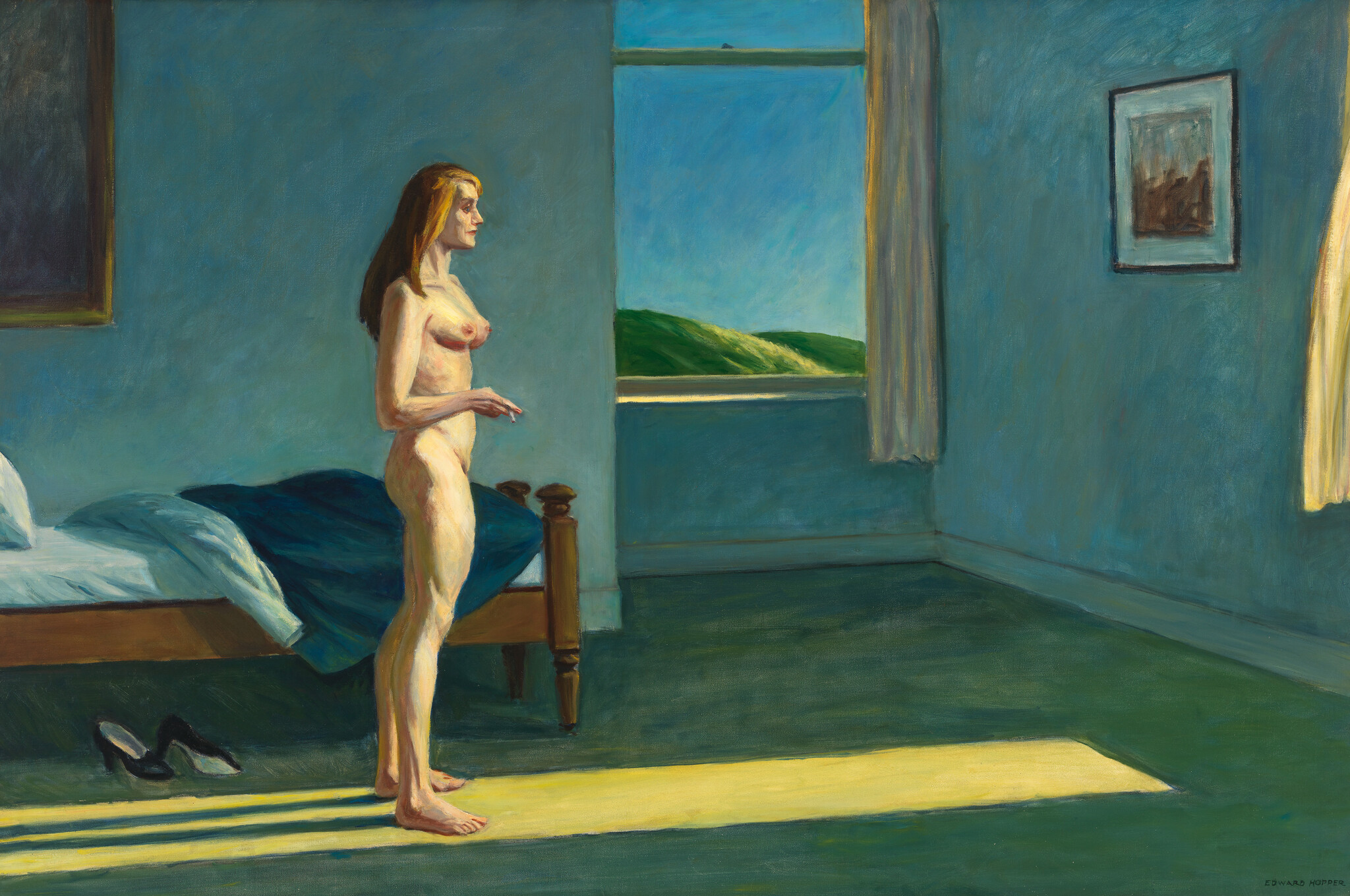
In 1961, Edward Hopper stood his wife in a box of morning light, nude, cigarette in hand, and painted the argument we have been having ever since. A Woman in the Sun has everything Hopper ever needed: a narrow bed, shoes parked underneath it, a curtain, a window looking out on hills that couldn't care less. Jo Hopper was seventy-eight when she posed for the figure. He painted her younger — call it a professional courtesy — but he did not paint her young. The body in that light has mileage on it, and the light reads every mile out loud.
Sixty-five years later, nobody agrees on what the painting says. Team Desolate sees the cheap room, the burned-down morning, a woman with nowhere to be and no one expecting her. Team Free sees a woman who got up, walked into the warm patch, and lit the first cigarette of the day because it is her floor and her sun. The painting refuses to referee. Hopper gives us her whole body and only a profile of her face, looking out the window at something we will never get to see — and that withholding is the engine that has kept the argument running for six decades.
Edward Hopper, A Woman in the Sun, 1961. Oil on canvas. Whitney Museum of American Art, New York; Josephine N. Hopper Bequest. © Heirs of Josephine N. Hopper / Licensed by Artists Rights Society (ARS), New York. View at the Whitney.
But look at the seating chart. She looks away. We look at her. It is the oldest arrangement in the history of the nude — the woman unaware, the viewer unaccounted for — and Hopper, who understood watching better than anyone who ever stretched a canvas in America, made the whole picture hinge on it. Desolate or free comes down to a fact the canvas won't hand over: is anyone watching her, and does she know?
Our figures can't ask the question quite the way Hopper asked it. His room is a dossier: the narrow bed, the parked shoes, the curtain — every object testifying about the life that gets lived there. Abstraction shreds the dossier. What survives is the machinery of light — a doorway, a set of blinds, a window — apertures that keep their shape while the furniture around them dissolves into paint. The room still stands; it just can't talk anymore. When the room stops talking, the light and the body have to do all of it. Here are four ways that conversation goes — three women at their apertures, and one who has no aperture at all.
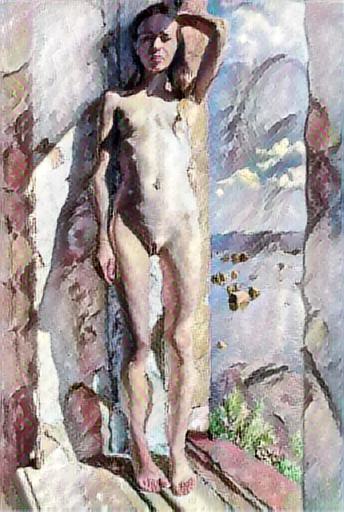
The first figure stands in a doorway, sun pouring through it, sea and small boats in the distance going about their business without her. By every artistic convention this should be the freedom picture — coast, open air, the whole postcard, and the way out standing wide open right behind her. Instead she is backed against the frame with her eyes shut, one arm up, enduring the light. Hopper relied on a sparse room to make sunlight feel like an interrogation. It turns out an open doorway and a beautiful coastline work just as well. The threshold is right there. She isn't stepping through it.
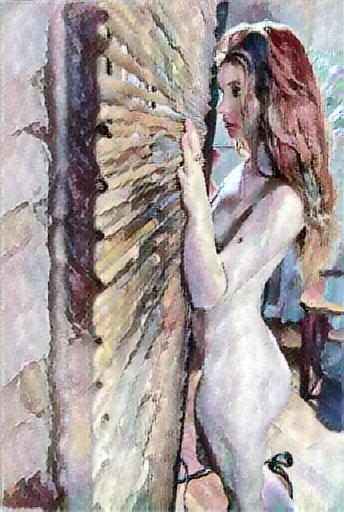
The second figure stands at the blinds — woven palm, slats fanned out like a hand of cards — and here is the detail worth sitting with: no light comes through them. None. Blinds exist to be looked through; light is supposed to leak in at the edges; these give her nothing. She waits at them anyway, in profile, close enough to touch. Hopper's window pours sun across the whole floor. Hers is closed for business. If his woman stands in the light deciding what it means, this one stands at the place light should come from, and it doesn't. She is keeping an appointment the sun isn't keeping.
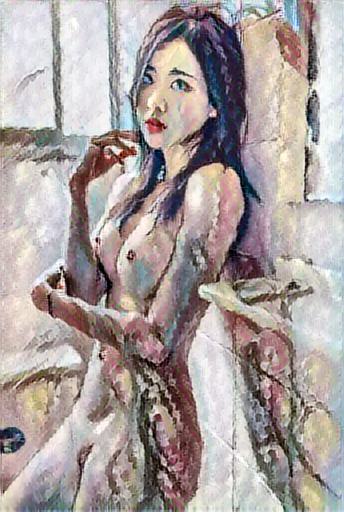
The third figure meets the light leaning against a convenient wall, at an actual window, one hand up near her mouth in a pose that will ring a bell for anyone who has spent time with Hopper. There is no cigarette, but the posture made it through: the angle of the elbow, the wrist's small privacy, the morning ritual performed for exactly nobody. It is the most domestic image of the four — she appears to be about her morning ablutions — and it makes the quietest case of them all: solitude is not an event. It is a routine. And routines are what hands do when no one needs them.
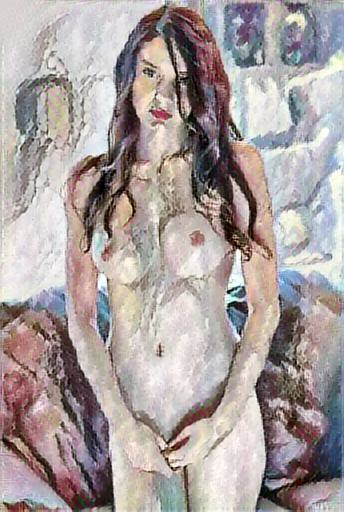
And then the fourth figure turns around.
Full length, hair down, facing us straight on, hands folded low in the oldest move in the business. Painters have been staging that gesture for five centuries — the Venus Pudica, the modest hands, the shielding placed at exactly the sightline where a viewer stands. It is a gesture with an audience built in. You cover yourself for someone.
Now look where she is looking. Straight at the spot where a watcher would stand. And the spot is empty. She is the only figure here without an aperture — no doorway, no blinds, no window to escape into, no hills, no elsewhere. Just the place where someone should be, and isn't. Hopper's woman looks away and lets us wonder whether she knows we're here. This one checked.
That is the answer sixty-five years of arguing kept circling without landing on. Desolate or free was never in the light — the same sun falls on both readings and warms them equally well. It was in the audience. A woman alone in the sun is free right up until the moment she checks. And her hands, still holding up their half of a bargain nobody else remembers signing, tell you she already did.