The Power and Soul of Disturbing Images
We all say we look to art for beauty. That's what psychologists call a stated preference. But some of the most powerful art we experience takes us pretty far from that preference. What we're actually drawn to is what's called revealed preference — what we do, not what we say we want. Years of physiological studies and all of our life experience with troubled loved ones suggests we humans aren't very good at introspecting on what we really value. Weird, huh?
Think of the most powerful black-and-white photograph you've ever seen. There's a good chance it was Dorothea Lange's Migrant Mother — one of the defining images of the Great Depression. A woman sits with a child asleep on each shoulder, a third child's back turned to the camera in her lap. Her hand rests at her chin, two fingers pressed lightly against her cheek — not a dramatic gesture, barely a gesture at all. Her eyes don't meet the lens. They look past it, toward something the frame can't hold: the next meal, the next mile, the next winter. Deep lines cut across her forehead. Her collar is frayed. And still — nothing about her reads as broken. There's a straightness to her spine that the poverty around her never manages to bend. It's a face that has run out of options and has not run out of resolve. That tension between exhaustion and endurance is the whole photograph. Learn more about the photograph.
To be clear, nothing you're about to see is in the same powerful universe as that photograph. But read on. There's a story to be told. Consider fine art abstract impressionist nudes — and the matter of disturbing images.
In most of the other 299 styles on this site, these two images are simply beautiful. Indeed, many styles emphasize strength and others vulnerability. None of that is happening here. The rough, blocky texture reads as distress.
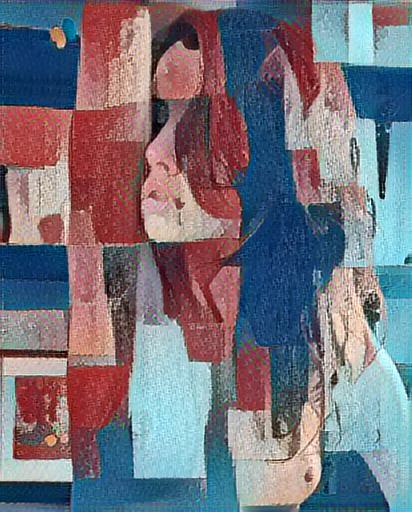
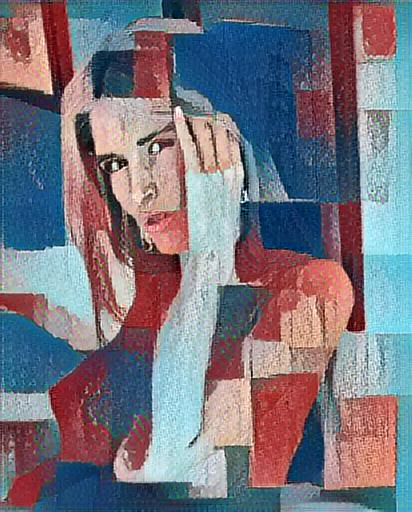
The fracturing itself becomes the subject. In the first image, the figure seems caught mid-turn — as if two moments, or two selves, are occupying the same frame at once. The second image closes the gap even further: a hand rises to the face, not quite hiding it, not quite reaching out either. The blocky palette of cool blue and brick red doesn't decorate the distress — it is the distress, the picture breaking apart the way the moment itself feels broken.
Heads are bowed — seemingly in stress or defeat.
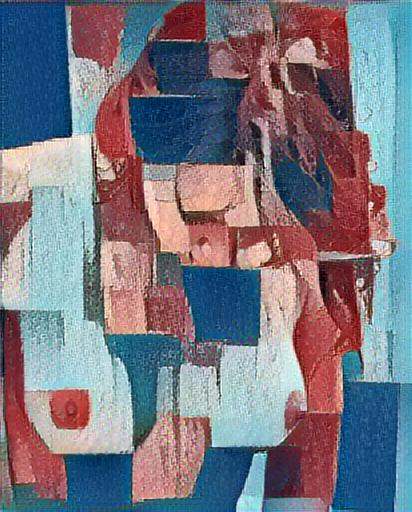
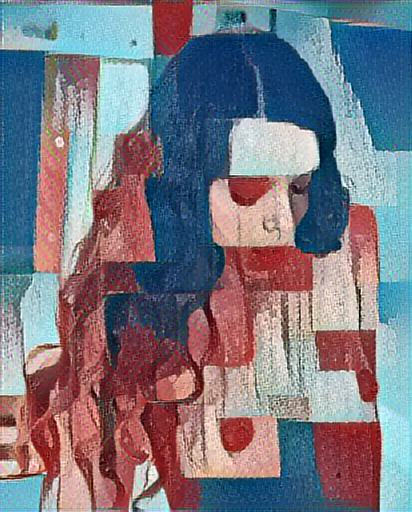
In the left image, a curtain of wind-tossed hair falls across the face, hiding as much as it reveals. In the right image, dark hair drops straight down like a veil, the mouth barely visible beneath it, the posture folded inward. We're certainly not drawn to these images because we're rooting against these women. Rather, their bleak circumstances cry out for compassion. It's almost impossible not to ask: what led to this moment? But it gets worse for our disturbing-image barometer.
These last two subjects have their eyes laser-focused on us.
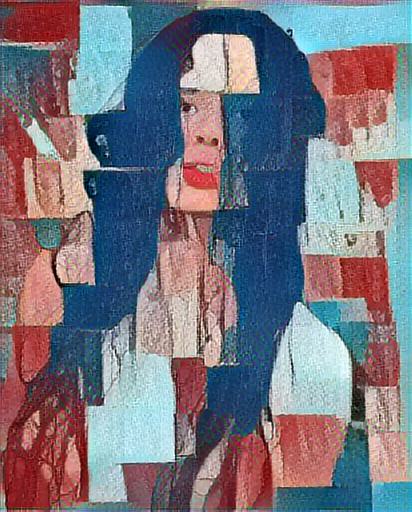
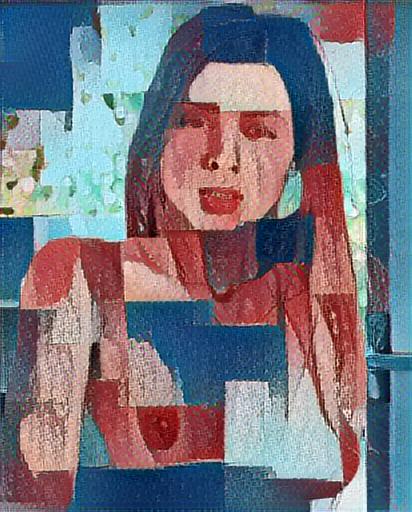
In the left image, long hair spills down over the shoulders and chest, half-shroud and half-shelter, the gaze heavy with something close to despair. In the final image, the chin lifts, the eyes meet ours head-on, arms drawn in — the same rawness, but with a spark of strength and resolve behind it. We're rooting for both subjects as we're drawn into their plight. Note: we're pretty far from any notion of classical beauty here.
Now it's your turn to reflect. Each of these images has a far more beautiful version — not remotely disturbing. Yet these may well be the most compelling versions of the images. Why in the world do we care to visit them?
Part of it is that, somehow, disturbing images bring a soul to an image that simple beauty cannot. But what else?
Let's step back and ask what the style itself had to do with any of this. Because here's the uncomfortable part: in a different light — literally, a different one of the 299 other styles — nothing about these six images reads as unsettling. Same women, same poses, same rooms. Rendered elsewhere in the catalog, several of them would look simply lovely. So the distress isn't a fact about the women, or even the poses — it's something the style itself is manufacturing.
But “manufacturing” is the wrong word for what's happening. A real person is never just one mood waiting to be captured in an image. The same woman, the same moment, could plausibly be joyous or grief-stricken, free or burdened — depending on what you already knew about her, or what you happened to notice first. All of that is sitting latent in her, all at once, the way it's sitting latent in any of us. What abstract impressionist style does isn't invent distress out of nothing. It reaches into that latency and pulls one thread of it forward, the way a different style would have pulled a different thread. The rough, blocky fracture didn't put grief where there was none. It found the grief that was already possible in her and decided that was the one we'd see.