The Back Story
Civilization has a long tradition of painting women from behind — the cave paintings at El Cogul, Spain, among the earliest known examples, are thousands of years old. Yet we have never quite known what to say about this artform. Go looking for commentary on the theme and you mostly find the same handful of tired words — sensual, luscious, beautiful — repeated across centuries without ever landing on why the pose keeps returning, or what it actually does that a face wouldn't.
Here's a start: what happens when you lose the face? No expression to read, no eyes to meet, nothing to tell you how she feels about being seen. So the meaning doesn't disappear — it moves. It goes into the room. The posture, the light, what she's doing with her hands, what's around her — all of it becomes a clue standing in for the one clue we don't get.
Six images, three pairs. Same absence of a face in every one. Watch how differently that absence reads.
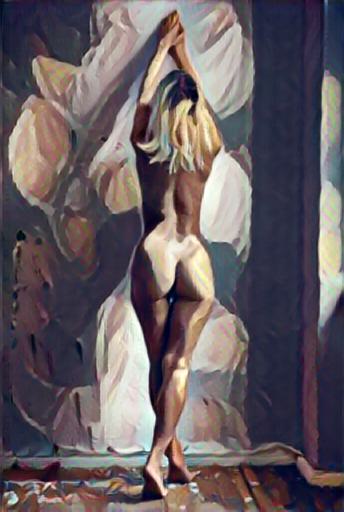
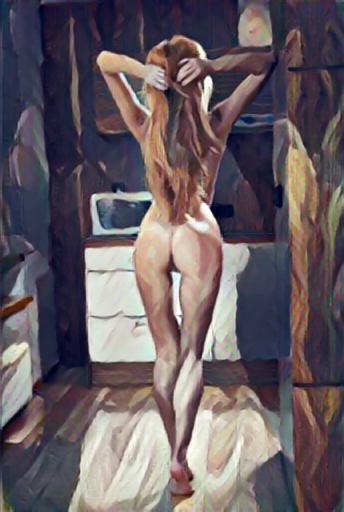
Arms raised in a stretch, or hair gathered back — a completely unremarkable gesture, the kind of thing a body does without thinking. In the first image, it's a stretch against sunlit stone. In the second, it's pulling her hair back in what's unmistakably a kitchen — countertop, cabinets, the ordinary architecture of a Tuesday. Neither woman is performing anything. That's the point. The back is most intimate not when the scene is dramatic, but when it's caught doing nothing in particular — the visual equivalent of walking in on someone mid-thought.
Now consider the same absence, staged.
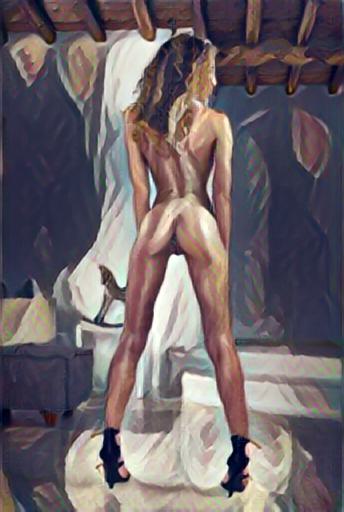
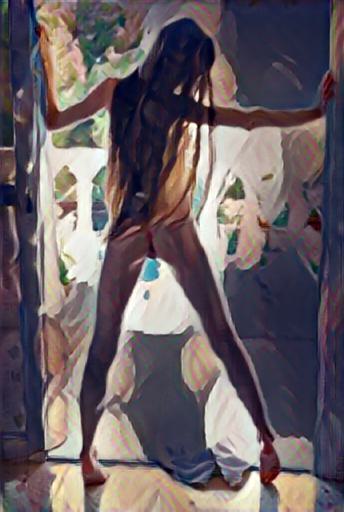
Heels, or up on tiptoe. An arched stance. A hand braced against a doorway, deliberate and held. Same missing face, same turned back — and an entirely different feeling. This is performance, the opposite of privacy. Which is this essay's real pivot: the back doesn't determine the mood of an image. It only removes the shortcut. Once the face is gone, everything else — the posture, the wardrobe, the way weight is held in the hips — has to do the work of telling you what kind of moment this is. We go from a captured, entirely private moment in the first pair to something entirely staged in this one. Could they feel more different?
And now, already leaving.
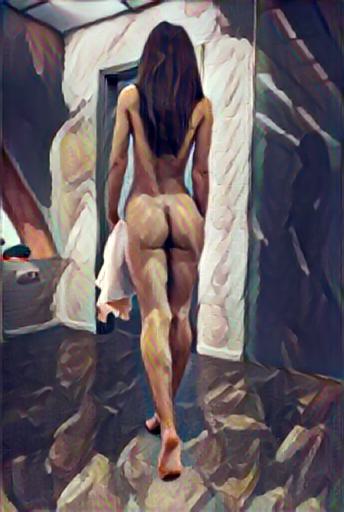
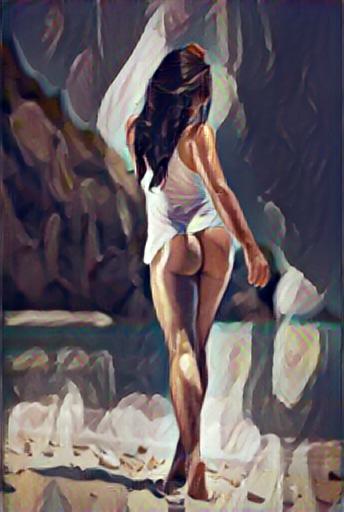
Both figures are mid-motion, walking toward a doorway. This is where the argument lands. These aren't women posed in a moment for us to study — they're women leaving. The back, here, isn't concealment or performance. It's departure. She was never available for a story in the first place; she was already on her way to the next one, and we happened to catch the trailing edge of it. And what are we to make of the gait? On the left, she appears to be walking away quite deliberately. On the right, maybe overselling the notion that she's happy to be moving on — or so the image wants us to believe.
Six images, nearly identical in anatomy and pose family. No face in any of them. And yet a private moment, a performed one, and a moment of departure all read as unmistakably different things. The face was never what told you that. Everything around it was.
In a way, this whole exercise is a kind of hyperbole — a deliberate exaggeration meant to make a quiet issue impossible to ignore. Meaning in any image is suggested by dozens of small clues at once, and in most portraiture, the face is where we let ourselves stop looking. It does the heavy lifting, so nothing else has to. Here, we took it away. What's left is a testament to how much work pose and context were always doing, whether or not the face was there to hide it. And it leaves a harder question sitting underneath the obvious one: if the room can talk us into privacy, performance, or departure this convincingly with nothing but a turned back, how much of what we read in a face was ever really there — and how much were we simply inventing?