The Background Isn't
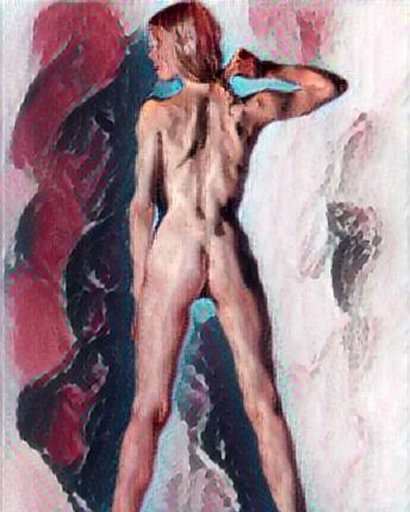
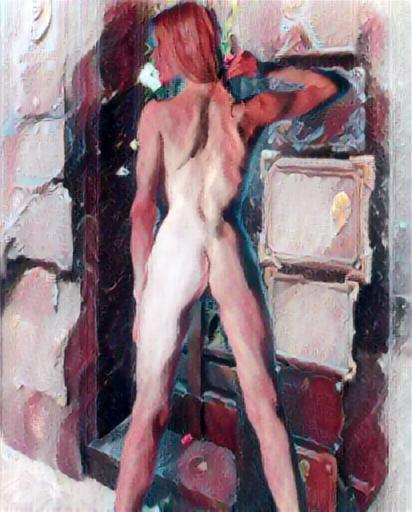
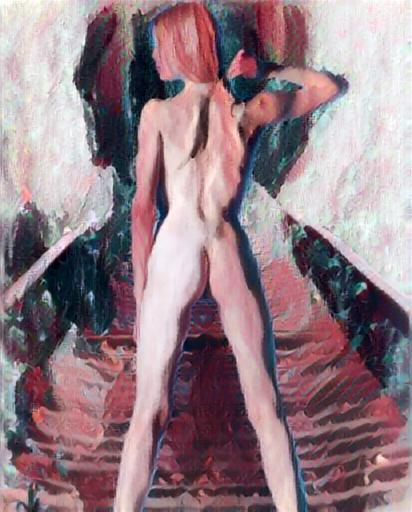
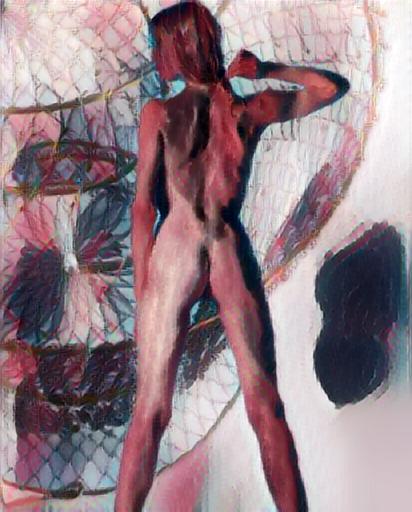
If abstract impressionist art is going to have any real power, beauty alone isn’t enough. The image has to invite interpretation. And more often than you’d expect, the background is doing most of that work.
The four images on this page make that case directly. They aren’t from the site’s catalog — we made them as a demonstration, pushing the backgrounds further than we normally would. The figure and the style are identical across all four. What changes is the background, and what the background changes is everything.
Power
The first background is purely abstract — deep, churning shapes that don’t resolve into anything you can name. The figure faces away from us, shoulders back, muscles defined. She seems to be facing something rather than posing for us. The image is ambiguous in a specific way: it doesn’t feel unfinished, it feels contested. The darkness isn’t setting the scene; it’s making a claim. Most people find this version more confusing than inviting on first look. A few find it immediately compelling. What do you see?
A Deliberate Detour: The Doorway
We made this one bad on purpose — so you could feel exactly what failure looks like. She’s standing at what reads as a doorway along a street, but the pose is wrong for that situation. The shading makes her look drawn rather than strong, and the tonal relationship between figure and ground is awkward in a way that none of the other three are. The background feels like a backdrop rather than a world she inhabits. Notice how your eye wants to leave the canvas. That’s the background failing at its job — and in doing so, actively damaging the figure. When background and subject don’t have a genuine relationship, you feel it immediately, and you feel it as a problem with the whole image, not just the setting. Why does this happen? Mostly it is what George Carlin identified as the “Left Nostril Inhaler” problem. Art, in pursuit of originality, loses focus — and because, in Carlin’s words, “some schmuck will buy it.”
Now Watch What Happens: The Path Ahead
Here the background earns its place, and everything changes. That horizontal element in front of her — a bridge? A threshold? Whatever it is, something waits on the other side, and the other side looks uncertain. Now look at the figure herself. She’s paler than in the first image, lighter, less defined through the back and shoulders. The strength has drained out of her, or been absorbed by the question she’s facing. This is what a background in genuine dialogue with its subject can do. It didn’t just change the mood. It changed her.
Time Storm
What is she facing now? The artist sees a kind of cosmic clock — organic, turning, not entirely benign. Others see a trap. Some see a storm. Nobody sees anything welcoming. Do you? The dark mass on the right complicates the composition in a way that takes a second look to fully register. And the figure has responded: she’s darker now, edged in shadow, carrying something of the same weight as what stands before her. This is the version most people return to. It demands interpretation and refuses to yield one. Compare this to the first image. What did the background profit the image?
We often invite visitors to find a favorite image and work with an artist to realize it at wall scale. This page is meant to complicate that — in the best way. Because your favorite image from the catalog might not be your favorite image possible. The background isn’t decoration. It’s an argument. And there may be a stronger argument waiting.