The Enigma of Clothes

You may be surprised to learn that curating this site involved a surprising number of pitched battles. The most fundamental one: should every image here be completely nude? The first version of the site said yes, full stop. And there’s something to be said for that purity — a rule with no exceptions is at least easy to enforce.
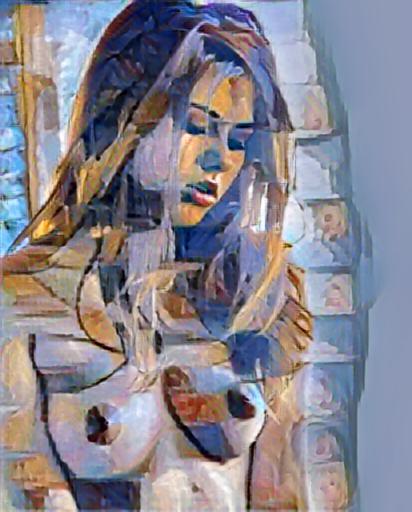
Take a look at the top image in the strip: a pure, simple nude. It doesn’t need anything else, and it doesn’t want anything else. No props, no costume, no cultural baggage — nothing standing between you and the image. It’s easy to invent a whole backstory for her in your head, because nothing on the canvas is arguing with you. If this is your sensibility, good news: something like 70% of the images on this site are exactly this. The rest you can scroll right past.
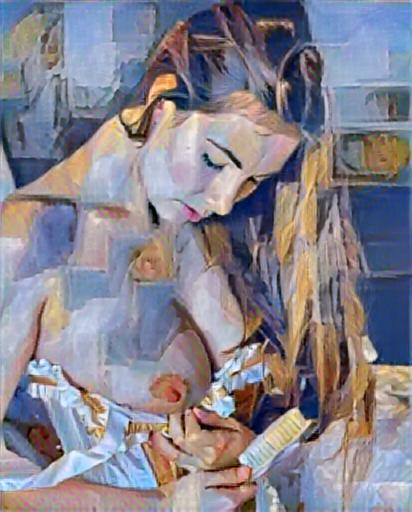
Now look at the second image down — the one that cracked the door open for everyone else. It’s quietly intimate — she’s brushing her hair, half-dressed, caught in a private moment rather than posing for one. This is the image we came closest to cutting for the sake of ideological purity. Some of the team still think we should have. You decide.
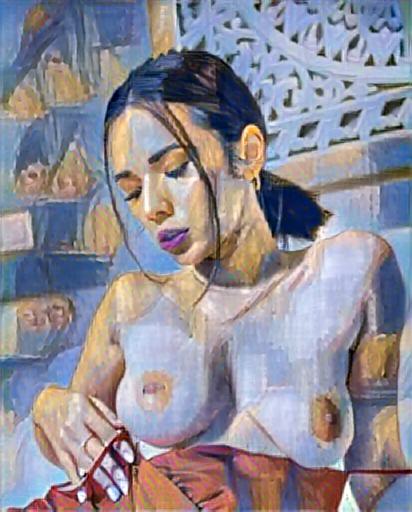
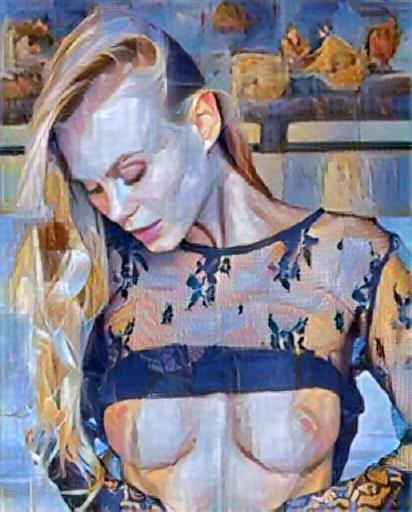
Next, find the third and fourth images in the strip. What are the clothes doing here — adding, or taking away? This argument is as old as figurative art itself. Look at classical statues of Venus or Aphrodite: some nude, some draped. And often, it’s the draped ones people find more compelling, because the sculptor got to turn the cloth itself into part of the story. We think abstract impressionism can lean on that same device. The background and the clothing shape how you read the model, and she shapes how you read them right back. In the fourth image, look closely at the grate over her shoulder and that red sash — they’re not decoration, they’re doing real narrative work.
And now we’re sliding down the hill into societal clothing semiotics. Sheer fabric, lingerie, a strap pulled aside — this stuff is not neutral. It means something to anyone who hasn’t spent the last decades in a cave. Less than 10% of the catalog falls into this bucket, and it’s also the most divisive 10%. At its best, it’s genuinely evocative — it adds a dimension the purely nude images can’t reach. At its worst, it’s a tired trope dressed up as art.
Our policy on this is simple: we let the audience decide. We watch which images get favorited, built into galleries, given a home. The ones nobody wants quietly disappear, replaced by something you might like better. Democracy, but for nudes.