The Mirror as Witness
Recommended music to listen to while looking at these images and reading this essay.
“The face in the mirror is hers. The woman looking back doesn’t always feel like it.” — written with Megan Moroney’s ‘Girl in the Mirror’ in mind
A mirror in an art image is never neutral. Almost always, it adds a second audience to the frame. The moment it does, the image is no longer just about the subject — it’s about the subject’s relationship with the artist. And, sometimes the mirror does something equally miraculous: it amplifies insight and yields genuine intimacy.
Let’s take a tour of this world.
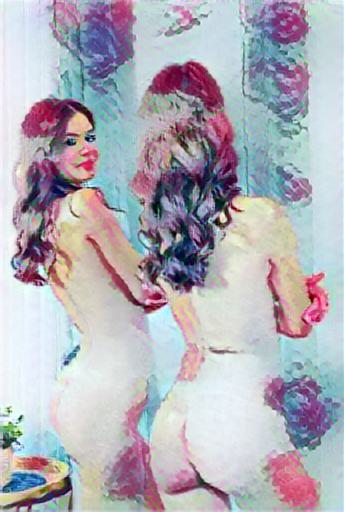
In the first of these images, the subject is posed for herself. The gaze is checking, adjusting, perfecting. Her smile suggests she is more than satisfied — or maybe not. We can’t fully tell, and that’s the point. This is the oldest mirror story in art, the one Caravaggio painted as warning: a figure caught in a closed loop with her own reflection, the rest of the world temporarily uninvited. But where Narcissus drowns in that loop, this image just lives in it for a moment. Self-regard isn’t punished here. It’s just observed — and, for that reason, this one may be the least interesting of the four. It tells us the least.
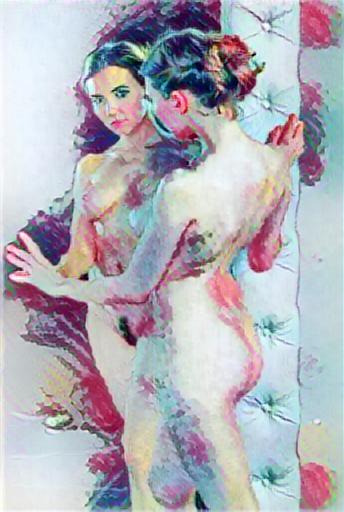
The second image is far more interesting, endearing, and even a little precarious. The subject is looking at two things at once — the artist, and herself — and the mirror won’t let either gaze fully win. Is she presenting herself for the observer, or checking her own presentation? The honest answer is that the image won’t resolve it, and asking it to do so is probably a mistake. What’s actually being shown is the gap itself: the half-second where self-presentation and self-assessment are the same gesture, indistinguishable even to the person making it. That’s not confusion in the image. That’s the content.
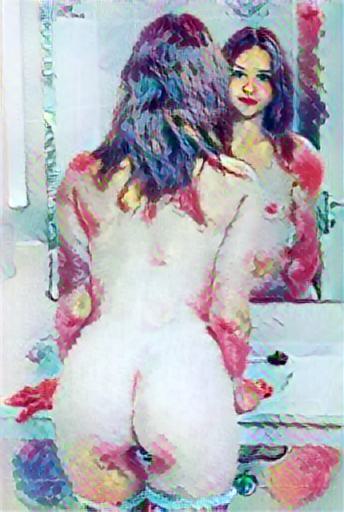
The third image is something different again. Standing at the sink, the mirror stops reflecting her self-awareness and instead simply gives us more of her — another angle on an unguarded moment, with the viewer discarded as her intended audience. We catch her in an everyday moment of intimacy — the same role the hairbrushing image plays in “The Enigma of Clothes.” We’re invited into something organic, unguarded. The image gains its power from how she holds it: neither vain nor self-conscious, but quietly questioning.
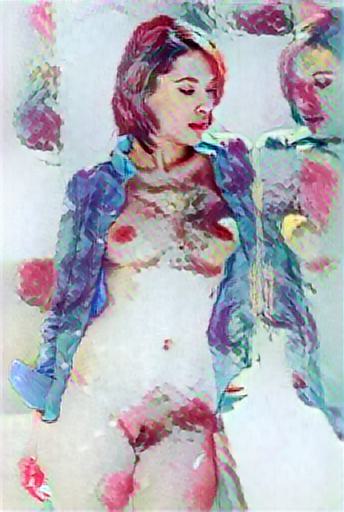
The fourth and final mirrored image closes her eyes. For her, the mirror no longer matters. For us, it still does. What is the reflection giving us, if not her? The echo is its own kind of beauty — serene, doubled, complete. The longer you look, the clearer it becomes: this moment holds real psychological complexity without a trace of drama. The reflection isn’t commentary here. It’s completion.
So where does that leave us? The mirror isn’t only psychological. Sometimes it’s closer to what mirrors did in old portraiture — Arnolfini’s convex mirror catching what the room itself couldn’t show. It expands the frame as often as it complicates the gaze.
Four images, four functions, one device. A mirror for rehearsal. A mirror for divided attention. A mirror for stolen intimacy. And, finally, one for quiet completion. The art-historical canon has names for pieces of this — vanitas, the gaze, the fourth wall, etc. — but the names came after the fact, applied to paintings that needed centuries of theory to be read this carefully.
The mirror was never just reflecting what was there. It was deciding what got seen, when, and by whom.