What the Colorist Knew (Bonnard)
Picasso called Bonnard’s work “a potpourri of indecision.” The mid-century verdict was harsher for being politer: a colorist. A decorator of surfaces. The word was meant to file him somewhere below the structural men — below Cézanne, below Matisse’s steel — as if color were the garnish of painting rather than a way of knowing.
Look at what the colorist knew.
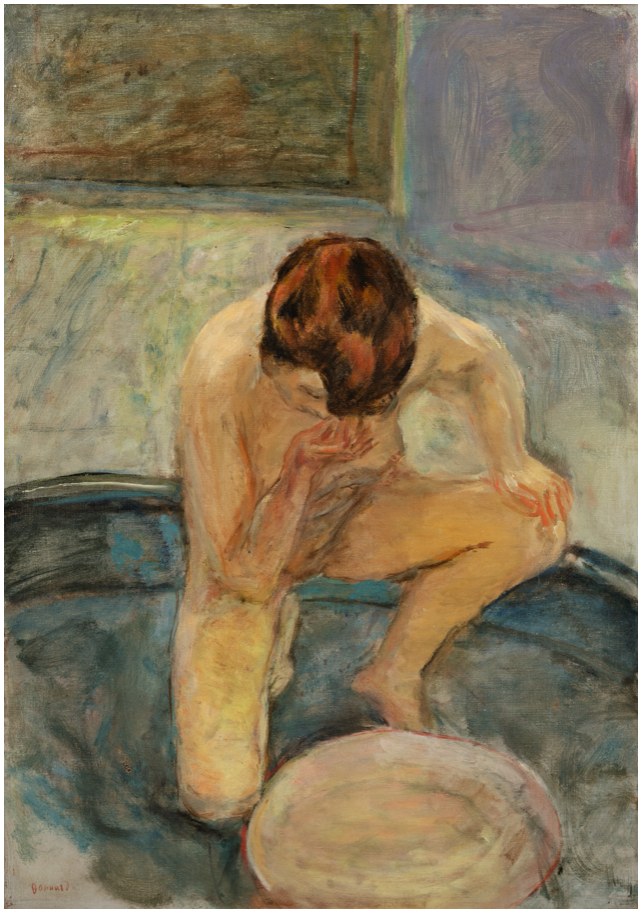
Pierre Bonnard, Femme accroupie (Nu au tub), 1913. Oil on canvas. Public domain, via Wikimedia Commons.

She crouches in the tub, face folded away, one hand at her cheek, doing the unglamorous work of washing. Nothing about the pose flatters her and Bonnard doesn’t rescue it. What he gives her instead is weather. The skin is not a color; it is a climate moving across a body. Violet pools in the shadow under the raised knee. Green creeps along the flank where the wall’s light reflects. Ochre gathers at the shoulder, rose at the ear, and a cold pewter blue rises from the water to claim the shins. None of these are the color of skin. All of them are the color of this skin, in this room, at this hour. The art world has since come around: “mere colorist” mistook the artist’s greatest contribution for decoration. Bonnard wasn’t decorating a body. He was recording the atmosphere a body lives inside, with an accuracy the structural men never attempted.
It is worth saying plainly: nothing in the figures below touches what Bonnard does with skin. And the comparison is not even fair in his favor — on paper, every advantage belongs to them.
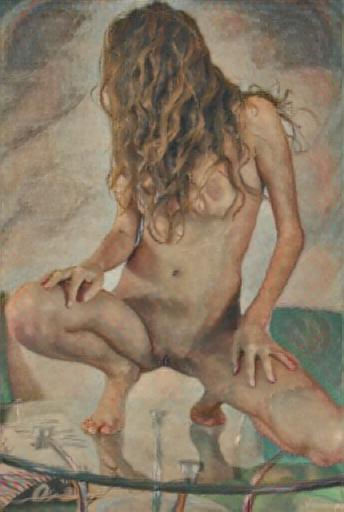
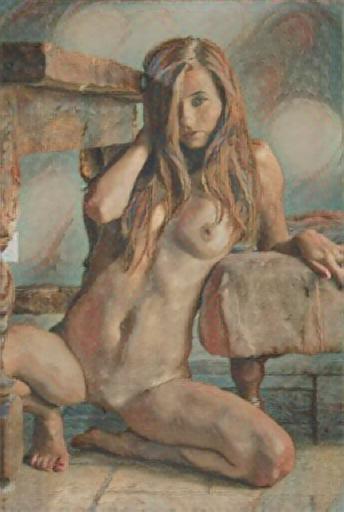
Consider what they’re holding. Bonnard’s woman is compressed into the least glamorous posture a body can take, face hidden entirely, doing chore-work in a tub. The figures here are built to win. The first squats in a pose full of coiled tension where the bather is a closed loop. The second kneels up into real light, a face, a downcast gaze that nearly meets you — and a century of portraiture says that contact should carry the picture. Eye contact is the cheapest, surest current of feeling in figurative art. Bonnard renounced it. These figures spend it freely.
And yet the current doesn’t arrive, and it is worth watching closely why. These are not flat pictures. The first figure is modeled with real care, grays and umbers turning the form — and at her hip, a cushion offers up its green, and the green stops dead at the edge of her. In Bonnard it would climb her flank. The second is warmer still, honest flesh tones against a wall washed in teal — and the teal never enters her, the warmth never leaks out. Warm figure, cool room, and a clean seam between them. That seam is the whole finding. Their skin is its own color: flesh-colored flesh, competently turned, sealed against the room it sits in. Bonnard’s discovery was that skin is a mirror — that a body borrows the violet of its shadows and the green of its walls and the hour of its day. These bodies, whatever their tone, are matte. The face makes its offer and the surface can’t fund it.
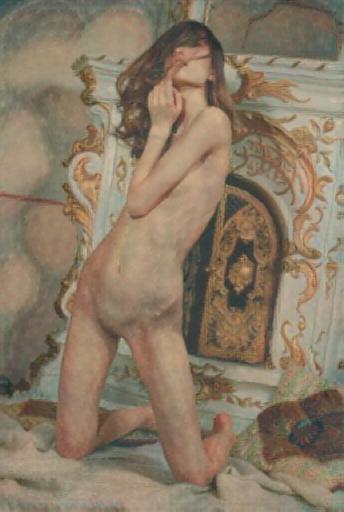
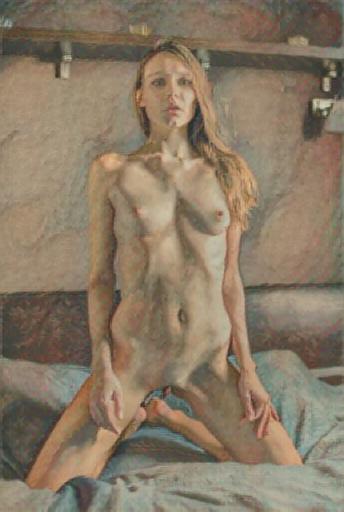
The second pair presses the experiment further. The third figure rises through a pose Bonnard never had — vertical, torqued, hair in motion, the body’s whole line dynamic where the bather’s is folded shut — and she rises against the loudest ground in the set, a wall of gilt and ornament blazing behind her. The room is shouting color, and none of it lands on her; she stays the palest thing in the picture. The last figure is the most direct in the set: frontal, kneeling, looking straight out, nothing withheld — and the most hour-less, gray-cool and even, the same register at the sternum as at the stone wall behind it. Between the two of them they hold every card the crouching woman in the tub was denied — movement, address, display, even rooms richer than her bathroom — and the pictures are still cooler than she is. A hundred years of painting taught us to expect temperature in skin, and the expectation is Bonnard’s doing. He is the reason the muteness registers as muteness.
That is the real answer to the colorist charge, and these four figures make it sharper than the tub picture can alone. Give a nude every advantage — the dynamic pose, the open gaze, the full display, the sumptuous room — and let the skin keep only its own local color, and the feeling doesn’t come. Hide the face, fold the body into a chore, and hand the whole picture to a colorist, and the feeling floods in. The variable isolates itself. Color was never Bonnard’s decoration; it was the entire delivery system for emotion, the thing doing the work the eyes were supposed to do. The dismissal got him exactly backwards. These four figures, dealt the better hand, are the proof.