How Abstraction Modernizes the Impressionist Nude
“When I use a word,” Humpty Dumpty said in rather a scornful tone, “it means just what I choose it to mean — neither more nor less.”
— Lewis Carroll, Through the Looking-Glass, 1871
Let's sort out what “Abstract Impressionism” does and should mean by starting from the beginning.
Realism gave us the body as it is. Courbet painted women nobody would mistake for a Venus — no myth, no drapery, no excuse for looking. An enormous gain in honesty. It also meant a painting could never be more interesting than whatever happened to be standing in front of the painter.
Impressionism broke that. It decided the subject wasn't the point; the light falling on the subject was. Renoir stood a woman under leaves and painted the shadows crossing her rather than the woman underneath. Painting stopped being a report and became an experience. The body came through it softened, but whole.
Abstraction broke that in turn. If the light mattered more than the object, why keep the object? Cubism took the body apart to see how it was built. Duchamp swapped it for machinery. De Kooning kept the teeth and discarded the rest. The gain was total freedom. The cost was the figure, and nobody sent flowers.
So — what can Abstract Impressionism do for us?
Not much, on the current evidence. Nobody has ever agreed what the words mean. Elaine de Kooning coined them in the fifties. The critic Louis Finkelstein pinned them on Philip Guston. Lawrence Alloway hung twenty-six paintings under the name in London in 1958, and that was more or less that. No painter of consequence has embraced it. Guston preferred “New York School.” Joan Mitchell refused labels on principle.
The two definitions still in circulation contradict each other on the only question that matters. Wikipedia's article currently opens by saying Abstract Impressionism means painting a subject — scenes, objects, people, portraits — in an Impressionist style with some degree of abstraction, often outdoors. Further down, the same article quotes Elaine de Kooning: you keep the Impressionist manner of looking, and you leave out the scene. One says the body can be in the picture. The other says the body is precisely what you remove.
And then there are the sellers. Search the term and you get furniture. Marketplaces, print shops, gallery listings — anything soft-edged and agreeable, filed under a label that sounds like it means something. Which is where Humpty comes back. The phrase currently means whatever the person saying it needs it to mean, and mostly what they need is to move inventory.
So the word is up for grabs. Nobody owns it, the two definitions cancel each other out, and its heaviest users are selling sideboards. That is not a reason to throw it away. It is a reason to decide.
Here is what it should mean. Abstract Impressionism is a graft: the scion is Impressionist light, the rootstock is abstract painting. From Impressionism we keep what is worth keeping — a subject you can recognise, light doing the work, the hand still visible in the surface. From abstraction we keep the permission: to stop transcribing, to push colour past what was in the room, to show what a body felt like rather than how it was built. Both at once, and nothing surrendered. That is what Abstract Impressionism should be.
One disclaimer before the images. This is a non-commercial site — nobody here is selling anything. It exists so people can explore this work, maybe learn from it, and, we hope, fall in love with abstract impressionist nudes. (The intro page explains more.) We are not claiming that any of these images is great art. The claim is narrower: they hint at what becomes possible when abstraction and Impressionism are grafted together.
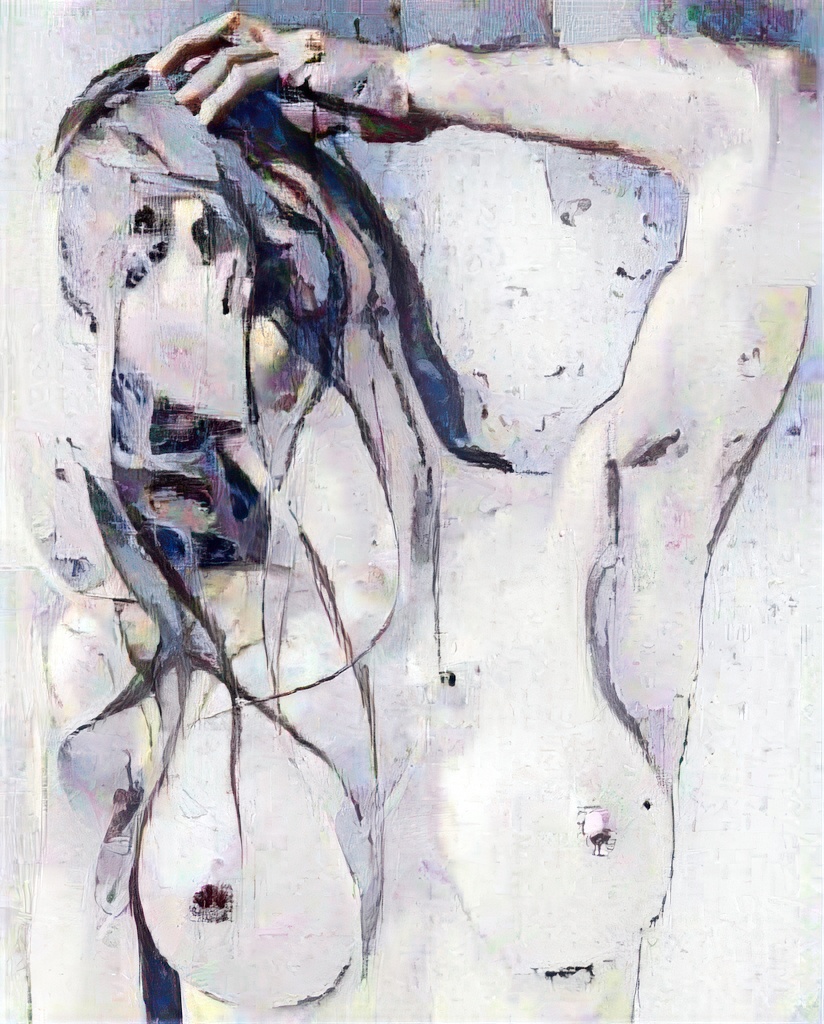
Start with how little is actually there. The torso is a few shifts of tone on white — no outline anywhere, no edge you could trace with a fingernail. By the rules of drawing it should have evaporated into the background. It hasn't. You know exactly where she stops.
Put your thumb over the hair and watch it nearly go. Those dark strands falling across the arms and the face are the only firm marks in the picture, and they do an outline's job without ever behaving like one — lying across the dissolve instead of containing it.
Renoir did this with dappled shade, at low volume. Turn the dial up far enough and the picture goes plainly abstract while she stays plainly there. That is the graft.
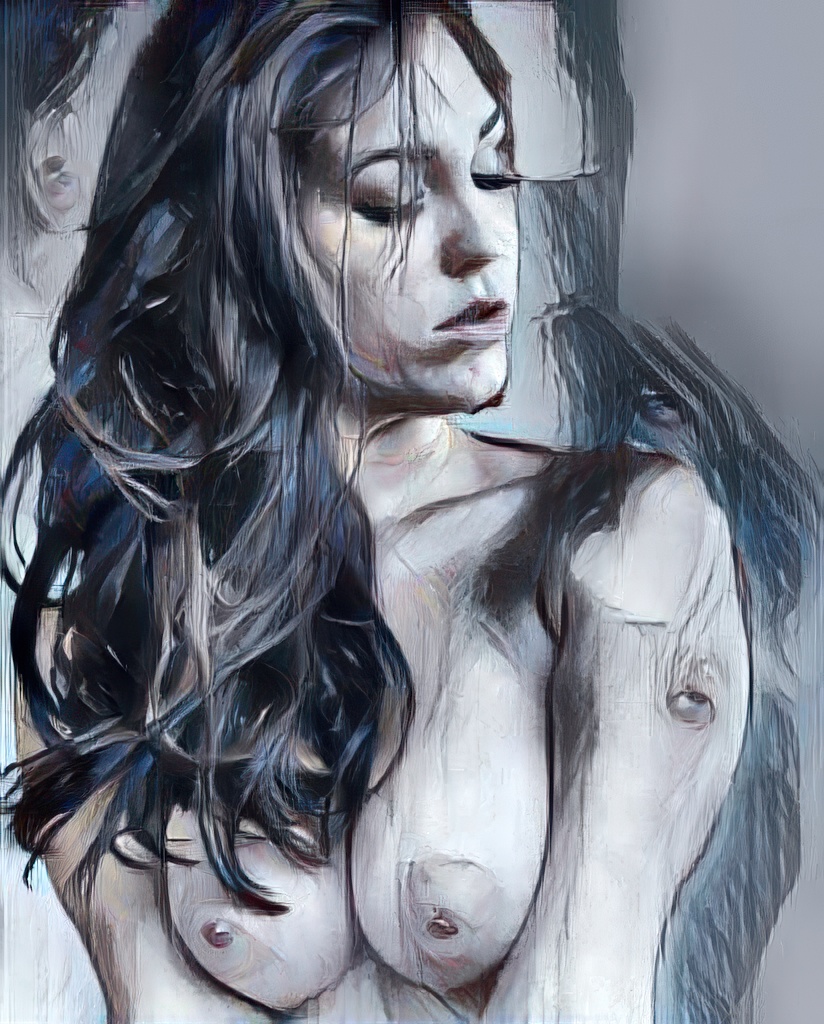
Call it blue and you'd be half right. The field is cool — blue-black hair, blue-grey working through every shadow, skin nearer white than flesh. But the warmth hasn't been removed, it's been rationed. A dark red mouth. A smear of red at the throat. Ochre buried in the hair. The nipples, holding the last of the pink. Take those few marks away and the picture goes cold; leave them in and the whole cool field reads as a body.
Now the edges. On the right, a second shoulder and a second breast ghost out of the first. Top left, another fragment of torso. No camera has ever done that. Not a reflection, not a shadow — the picture declining to settle on one account of where her body is.
Which answers anyone who looked at the last plate and thought: pale photograph. This one cannot be mistaken for a record of anything. And she is still, entirely, there.
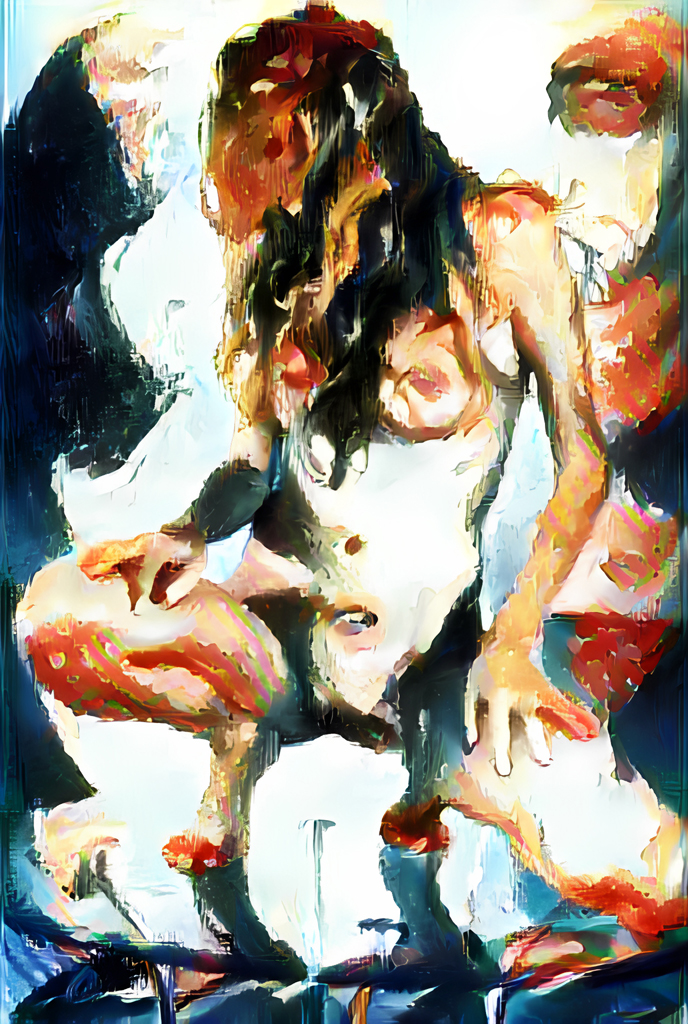
Give this one a second. It doesn't arrive all at once — first it's weather, red and ochre blowing across white, and then a back assembles out of it, then a shoulder, then the dark fall of hair, then the hand braced at the left. Nothing was added while you looked. You just caught up.
The stripes are where it goes furthest. Those diagonal bands down the back and the thigh run red and green and magenta side by side, and no skin has ever done that. Nor does the white stay behind her — the same strokes run through the body and the ground without asking permission.
And once it settles, look at what she is doing. Crouched, turned away, wholly occupied with something that isn't us. Degas painted that woman a hundred and forty years ago, in a shallow basin, at the last Impressionist exhibition. Here she is again, made of nothing but weather.
* * *
Three pictures don't settle a definition. They do show the thing is available — a body dissolved by light, carried past where Renoir was allowed to take it, and still there at the end of it. Not braver, just later. He spent his nerve on the conventions of 1876; abstraction spent a century on the rest. We only had to plant.
That is what the words could be worth. Not a style, not a mood, not a softer grade of Abstract Expressionism. A graft, and a working one. And it takes on more than bodies: a library, a march, a stadium.
Humpty was right that a word means whatever you choose it to mean. What he left out is that some choices are worth more than others. This one has a century of unfinished business behind it, and nobody is guarding the door.