Why Abstract Painting Lost the Nude
In 1876, at the second Impressionist exhibition, the critic Albert Wolff stopped in front of a Renoir nude and described what he saw as a heap of decomposing flesh. In 1913, at the Armory Show in New York, crowds queued to jeer at a painting called Nude Descending a Staircase and came away complaining that they could not find the nude.
Two scandals, thirty-seven years apart, both provoked by a painted body. But listen to what each crowd was actually angry about. Wolff's objection was that there was too much body and that it had been observed too honestly — that Renoir's fidelity to what light does to skin had produced something that looked diseased. The Armory Show's objection ran the other way: a title had promised a nude and delivered a cascade of brown planes. One audience saw a body it wished it hadn't. The other went hunting for a body and found machinery.
Almost everything that happened to the nude in modern painting fits between those two complaints.
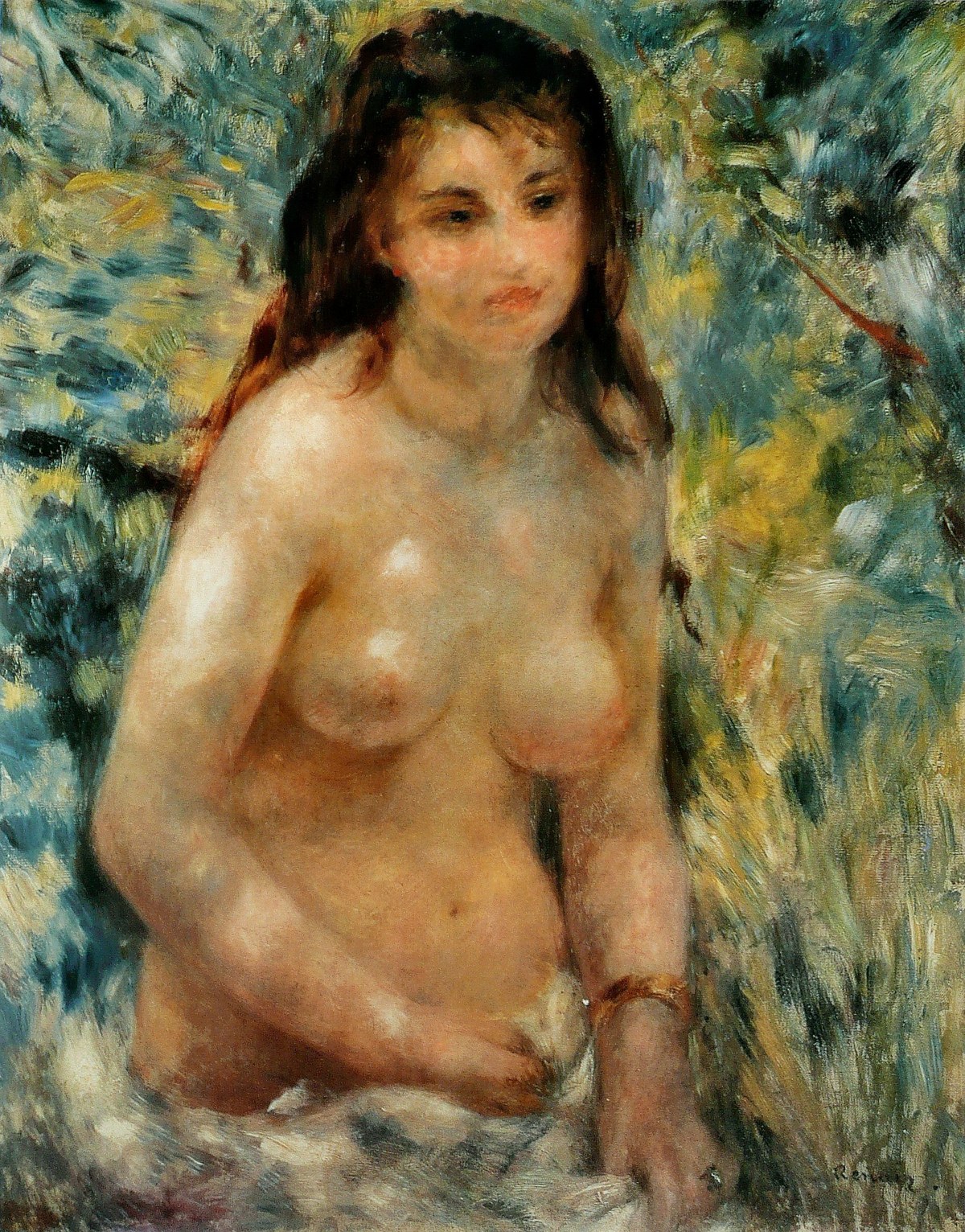
Impressionism is usually described as a revolution in how painters saw light. For the nude it was something more specific: a revolution in what light was permitted to do to a body.
Nude in the Sunlight puts a woman under leaves and lets the light fall where it will. Green and violet crawl across her shoulders. Contours soften where the sun strikes hardest. Renoir suppressed the nipples and the navel almost entirely — the surface markings a classical nude relies on to insist that this is a body and not merely a shape — and modelled the whole figure with nothing but light.
And the figure survives. That is the fact to hold onto, because everything later depends on it. Renoir dissolved the surface of the body: its edges, its local colour, the dependable pink that academic painting used for skin. He did not dissolve the body. You can still say where she ends and the garden begins. You could still, if you were Wolff, be scandalised by her.
Degas ran the same method with opposite social manners. The Tub, shown at the eighth and final Impressionist exhibition in 1886, looks down on a woman crouched in a shallow basin, wholly absorbed in washing herself. Degas almost never painted a woman who knew she was being watched, and the difference between his bathers and Renoir's is a difference of address, not of method. Light still does the modelling. Pastel keeps the drawing and the colour in a single gesture. The body is just as intact.
So the first fact: optical dissolution does not destroy a figure. Light can carry a body most of the way to abstraction and hand it back whole.
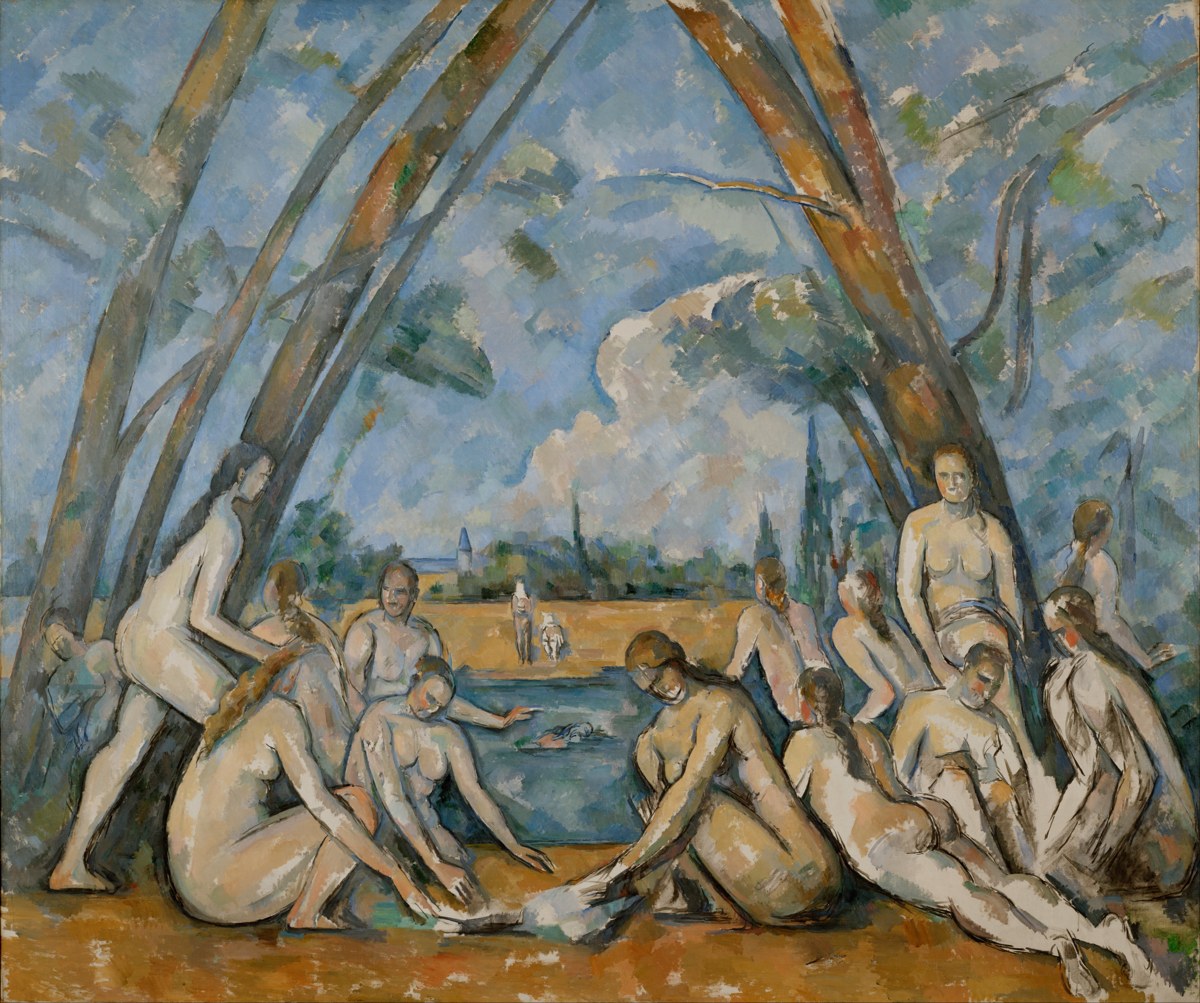
Then something changes, and Cézanne is where you can watch it change.
The Large Bathers occupied him for the last years of his life and was first exhibited in 1906, the year he died. The bathers are still recognisably bodies, and light is still doing work. But something else has taken command of the picture. The figures have been bent to fit a composition — two trees leaning inward to make a pediment, the bodies arranged along its slope, limbs simplified into wedges that answer other wedges elsewhere on the canvas. They are no longer women being lit. They are shapes being organised.
That is a different solvent. Light softens a body; structure rearranges it. Cézanne is the point where the second one starts carrying the weight, and nearly every abstraction that follows passes through him to get there.
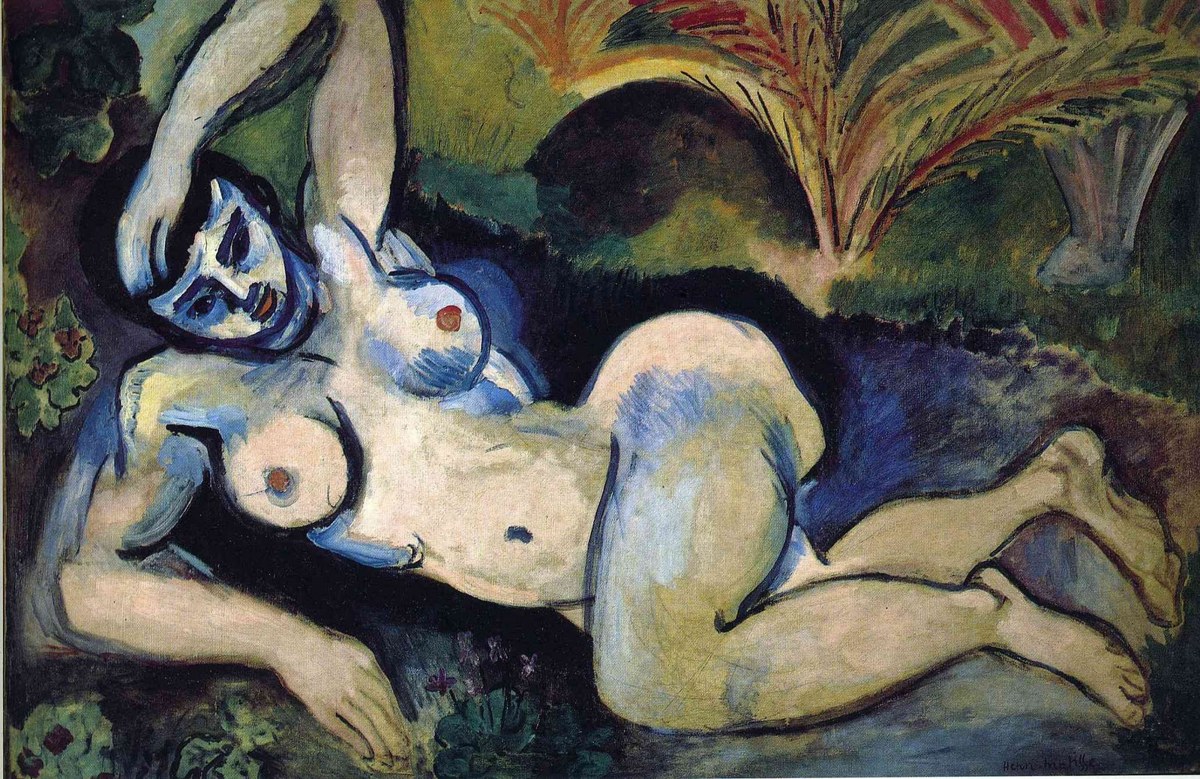
Take structure to its conclusion and the figure stops surviving.
Matisse's Blue Nude (Souvenir de Biskra), painted in 1907, is the last stop where you can still call the figure a body without argument. The pose is a classical odalisque. The drawing is violent. The hip swells past anatomy, the leg crosses at an angle no leg makes, and the blue that gives the picture its name is a shadow that has stopped behaving like a shadow and become a decision. She is a body — but a body that has begun losing the argument with the painting she is in.
Set it beside the Renoir and one detail carries the whole case. Renoir dissolved the nipples nearly out of existence; light crossing the chest left barely a change of tone. Matisse redraws them as two flat orange discs, outlined, sitting on the surface like punctuation. The same marks, opposite fates. Light softened them until they almost vanished. Structure hardened them into signs.
Five years later Duchamp finishes the argument. Nude Descending a Staircase, No. 2 contains no nude. A figure is implied — the title insists on it, and the block capitals painted along the lower edge insist again — but what is actually on the canvas is a sequence of positions, a body distributed across time in ochre and brown planes. Duchamp had a word for the art he was refusing: retinal, meaning painting that addresses only the eye. It is a term aimed with some precision at Impressionism, which is the purest retinal art the Western tradition ever produced. His nude was built to be unseeable and only thinkable.
De Kooning closes it four decades on. Woman I, painted and scraped down over roughly two years, retains exactly enough — teeth, eyes, breasts — to prove the destruction was deliberate rather than incidental. He framed the picture as a confrontation with the entire lineage of the idol and the Venus, and it looks like one.
Three paintings, one direction of travel. In each, structure or gesture is the solvent. In each, the body comes out the other side broken. Nobody in this line is doing to the nude what Renoir did.
At this point the vocabulary starts getting in the way. Four terms describe this territory — Impressionism, abstract, Abstract Expressionism, Abstract Impressionism — and they are habitually used as though they named four comparable movements. They don't. Three of the relationships between them are containment, and the fourth is not a relationship between sets at all.
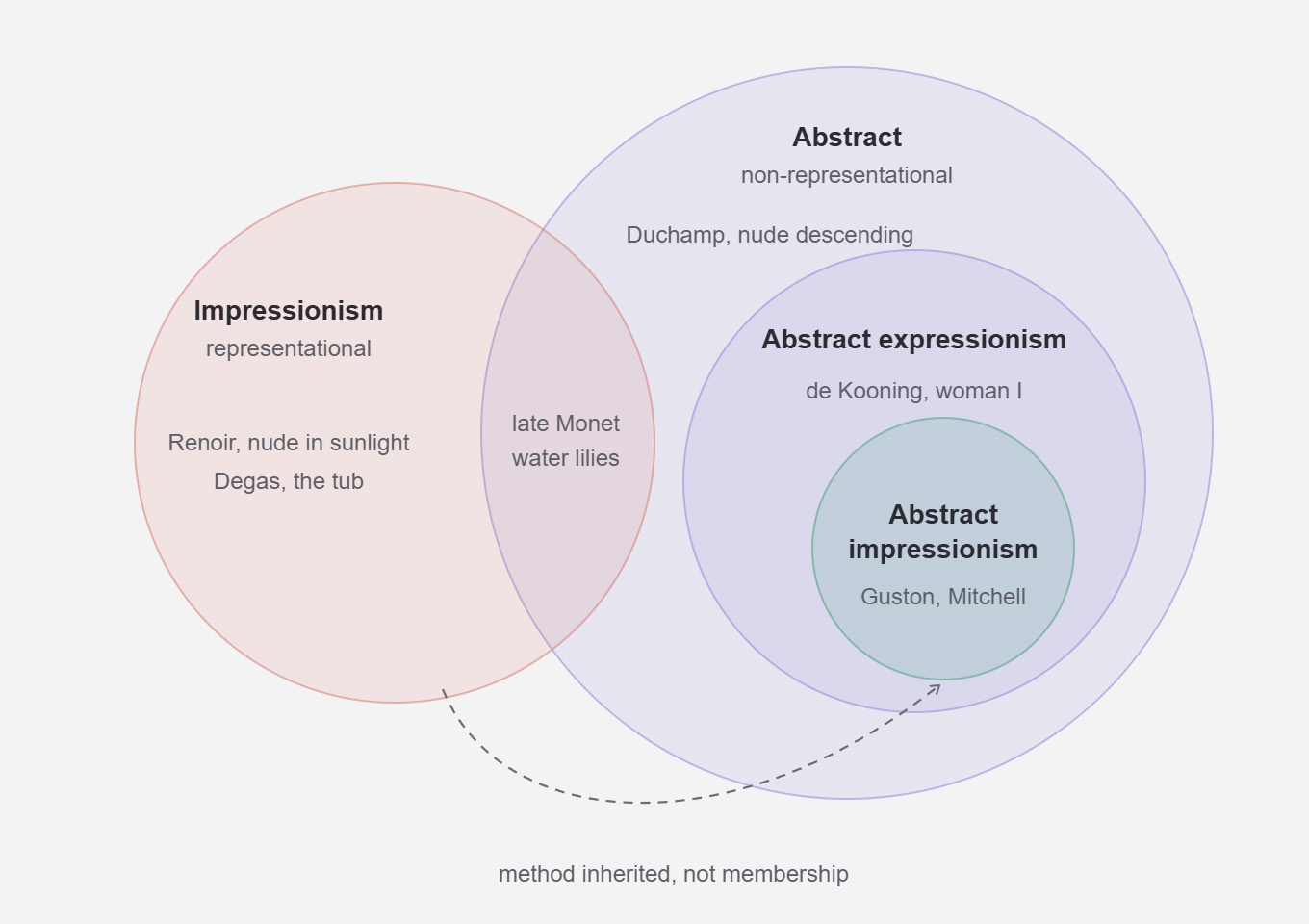
Abstract is not a movement. It is a property — non-representation — which is why it belongs as the container rather than as a peer. Abstract Expressionism sits inside it: a specific group, in New York, in specific years. Abstract Impressionism sits inside that, a smaller and quieter strand of second-generation New York painting.
Impressionism sits almost entirely outside abstraction, for the straightforward reason that it is a representational movement. The single real overlap is the late Monet — the Orangerie water lilies, which the 1950s read backwards as proto-abstract, and which is the reason the overlap exists at all.
The fourth relationship, drawn as a dashed arrow, is not intersection but inheritance. Abstract Impressionism took Impressionism's method without ever joining its set. That is why a Venn diagram cannot express this territory: Venn diagrams show overlap, and the most consequential connection here is descent.
Now look for the position that isn't on the map.
Nowhere does a body sit inside abstraction with Impressionist light on it. Renoir and Degas are in the left circle only. Matisse, Duchamp and de Kooning are in the right one only. And the innermost circle — the one movement that inherited Impressionism's optical method entire — contains no nudes whatsoever. Guston's Zone is a mist of red cross-hatching. Mitchell's Ladybug is remembered landscape. Sam Francis, Riopelle, Resnick: not a figure between them.
That gap is not an accident of which paintings happen to have become famous. It is structural. The two things that would have had to combine never occupied the same room.
The reason is a matter of timing, and it borders on absurd.
Abstract Impressionism is the one movement in the whole sequence that possessed the surviving method. Its entire identity is Impressionism's handling — small deliberate strokes, all-over shimmer, colour behaving as light — carried across into abstraction. Elaine de Kooning coined the term in the 1950s. Louis Finkelstein applied it to Guston. Lawrence Alloway hung the first exhibition under the name in 1958: twenty-six paintings by twenty-three artists.
And Elaine de Kooning's own account of what those painters were doing was this. They keep the Impressionist manner of looking at a scene, but leave out the scene.
Leave out the scene. The method that had been demonstrated on Renoir's canvas to dissolve a body without destroying it — the one solvent a figure survives — arrived in abstraction with the subject already deleted as a condition of entry. By the time painting had a way of abstracting that spares the body, it had thrown the body out. The body was not the only thing that went out with the scene. So did the world it stood in.
One caution about the map above, and it is the reason there is a companion to this essay.
That categorisation is the canonical one, but it rests on a single definition, and the definition is contested. Wikipedia's article on Abstract Impressionism opens by describing the movement as painting a subject — scenes, objects, people, portraits included — in an Impressionist style with varying degrees of abstraction, frequently outdoors. Further down the same article, it quotes Elaine de Kooning saying the scene comes out.
Both cannot be right. One definition puts the nude inside Abstract Impressionism as a matter of course; the other rules it out as a matter of definition. The map drawn here follows the second, because that is the reading the term's own authors gave it.
Whether that was the right choice — and what follows if it wasn't — is the subject of the next essay.